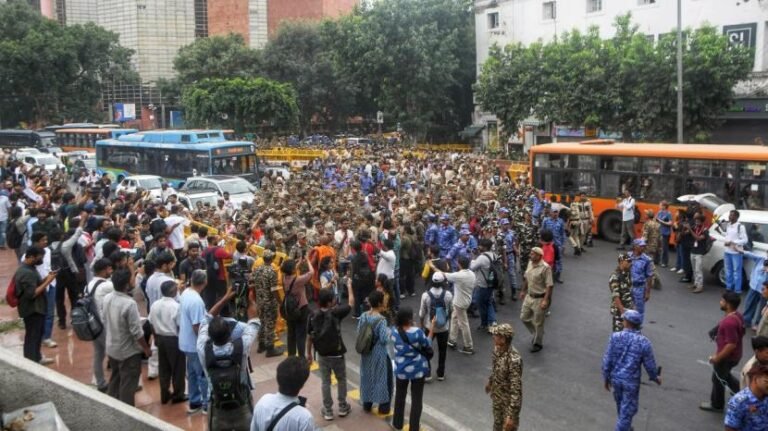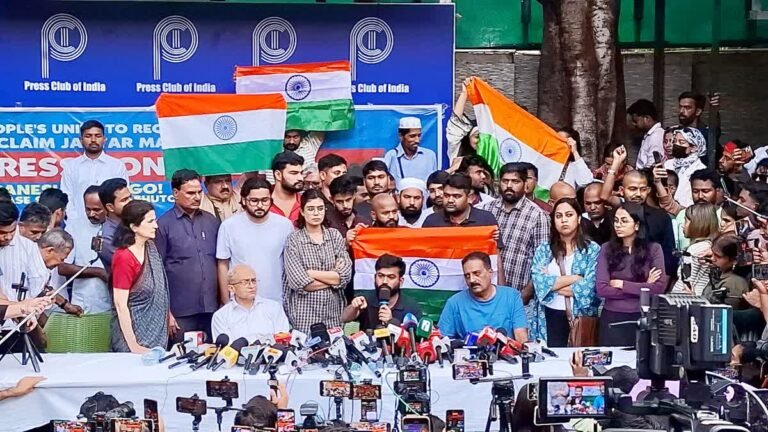

The investigation into cases involving ‘Cockroach Janata Party’ (CJP) leaders Ashutosh Ranka and Sourav Das—linked to incidents at Jantar Mantar and Connaught Place—has now been handed over to the Delhi Police Crime Branch. Both cases, registered on October 13, have been transferred to the Crime Branch, which will now conduct the investigation. One case pertains to entry into the Connaught Place area, while the other relates to their alleged entry into the Jantar Mantar area.
According to the Delhi Police, Ashutosh Ranka, Sourav Das, and other CJP members arrived at Jantar Mantar on October 13. The police attempted to stop them, as Jantar Mantar has been removed from the list of designated protest sites. The police allege that the group entered the restricted area via a private property and crossed police barricades. A total of 14 individuals were taken into custody, and two separate cases were registered in connection with the incident.
Ashutosh Ranka and Sourav Das were remanded to five days of judicial custody on October 14. Subsequently, on October 19, the Special Executive Magistrate extended their custody by another two days—a period that concludes today, October 21. Both are currently being held in Tihar Jail.
Meanwhile, the two leaders have challenged their detention in the Delhi High Court. Their petition alleges that they were not released despite the submission of necessary bail documentation, and argues that the decision to extend their custody violates their right to personal liberty. They have requested an urgent hearing and their immediate release.
Their petition was heard in the High Court today. During the proceedings, the Delhi High Court inquired about the ages of both Ashutosh Ranka and Sourav Das. Following this, the court remarked, “Neither of them belongs to ‘Gen Z’—one stated their age as 27, while the other said 31. Initially, this was a student protest that even included children, but the nature of the protest has since shifted.”
The court observed that while the individuals remain the same, the objective of the protest has changed. “Who are you? Which organization are you affiliated with, and what is the purpose of that organization?” The court noted that when there is a risk of a breach of peace, it becomes essential to seek answers to such questions. It further questioned whether a magistrate, when assessing the apprehension of a breach of peace, should take into account the nature of groups whose issues and objectives appear to evolve over time.
During the hearing, Additional Solicitor General (ASG) Chetan Sharma informed the court that a formal response had not yet been filed before the Special Executive Magistrate (SEM) court; the court noted that the magistrate would take this into account. ASG Chetan Sharma also alleged that there had been discriminatory treatment in the matter. He further raised concerns regarding the cancellation of bail bonds and requested a reconsideration of the requirement for four sureties. The hearing concluded thereafter.