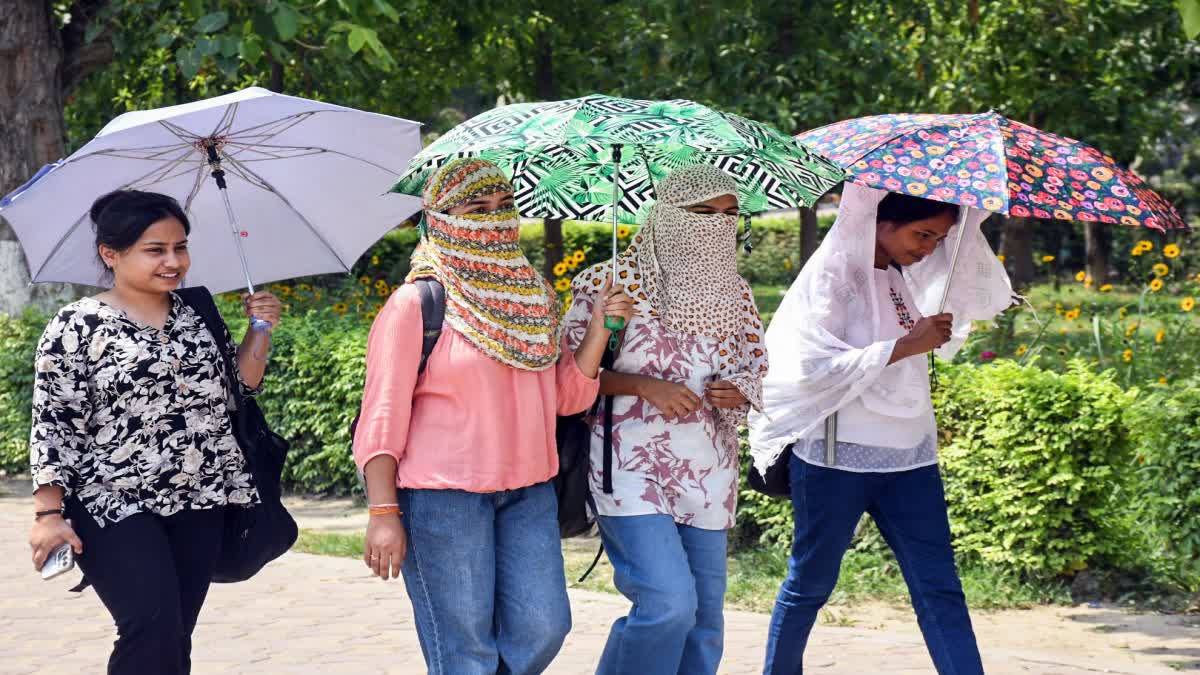
India is currently witnessing two starkly different weather patterns simultaneously: while scorching heat persists across the northern plains, pre-monsoon activity has intensified in several other parts of the country.
The India Meteorological Department (IMD) has issued an alert for 14 states, warning of thunderstorms, lightning strikes, and strong winds gusting up to 70 kilometers per hour over the next 12 hours.
According to the IMD, unstable weather conditions are likely to prevail across large parts of the eastern, northeastern, and Himalayan regions due to the advancement of a pre-monsoon system.

Heavy to very heavy rainfall is forecast for the coming days in Sub-Himalayan West Bengal, Sikkim, and several northeastern states. Meteorologists have also noted that conditions are becoming increasingly favorable for the further advancement of the Southwest Monsoon across the southeastern Arabian Sea and the remaining parts of the Bay of Bengal.
While rain-bearing systems are strengthening in one part of the country, North India continues to reel under intense heat. Delhi, Uttar Pradesh, Rajasthan, and parts of Central India are still experiencing extreme heat, with temperatures in several cities hovering close to 46°C.
An “Orange Alert” is expected to remain in effect for the national capital over the next few days. Dry north-westerly winds and hot air blowing in from the Thar Desert have significantly driven up daytime temperatures.
The IMD has warned that maximum temperatures in Delhi could range between 44°C and 46°C, potentially leading to “warm night” conditions—a situation where temperatures remain unusually high even after sunset.
Anand Sharma, former Additional Director General (ADG) of the India Meteorological Department (IMD), told ETV Bharat that as long as the heatwave persists, people should avoid venturing outdoors during the peak afternoon hours. He stated, “A heatwave is currently underway; everyone is advised to avoid venturing outdoors between 10:00 AM and 3:00–3:30 PM—particularly pregnant women, the elderly, children, and those who are unwell.”
Sharma added, “Travelers should endeavor to postpone their journeys if at all possible. People should wear light, protective clothing and keep their heads covered to shield themselves from direct sunlight falling on their heads and faces. They should also carry water with them to stay hydrated.”
Manu Singh, an environmentalist based in Delhi, remarked, “Today’s scorching heat is no longer merely a seasonal inconvenience. It serves as a civilizational warning—one that is being painfully reiterated on a daily basis. The ‘urban heat island effect’—spawned by unchecked concretization and the depletion of green cover—is altering not only our climate but also our collective physiology and psychology. Excessive heat exhausts the body, disrupts sleep, heightens cardiovascular stress, and insidiously exacerbates anxiety, aggression, and emotional fatigue.”
“The suffering of the voiceless—birds succumbing to dehydration and destitute animals desperately seeking shade and water—is equally tragic. Ecological imbalance is, ultimately, a spiritual imbalance. A city that fails to safeguard its most vulnerable forms of life risks forfeiting the very soul of human civilization.”