
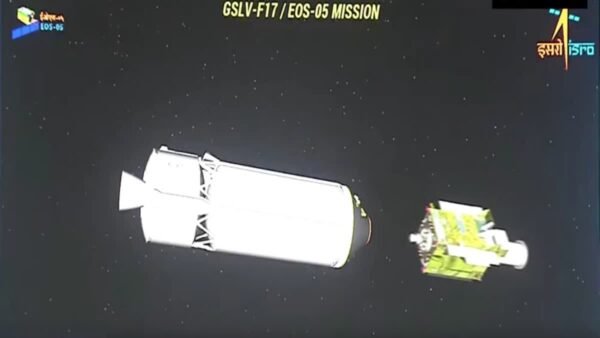
Delhi: The Indian Space Research Organisation (ISRO) successfully launched the Earth Observation Satellite EOS-05 from the Satish Dhawan Space Centre in Sriharikota on Friday. This marks another major achievement in India’s space program.
ISRO Chairman Dr. V. Narayanan stated, “I am delighted to announce that the GSLV-F17 vehicle has successfully and precisely placed the advanced Earth Observation Satellite EOS-05 into the designated orbit.”
Designed to provide real-time imagery and assist the nation in sectors such as agriculture and disaster management, the GSLV-F17 rocket lifted off from the spaceport at 2:55 AM (IST), carrying its payload into the sky.
Another giant leap for India in Space!
Kudos to Team @isro on the successful launch of GSLV-F17/EOS-05.
EOS-05 is a state-of-the-art Earth Observation satellite and India’s first imaging satellite from Geosynchronous Orbit, enabling advanced imaging across visible, infrared,… pic.twitter.com/1HHJrWM7ze
— Dr Jitendra Singh (@DrJitendraSingh) September 3, 2026
The launch was conducted using the GSLV-F17 rocket, marking the 19th flight of India’s Geosynchronous Satellite Launch Vehicle (GSLV) and its mission to place EOS-05 into a sub-Geosynchronous Transfer Orbit (sub-GTO). Commending ISRO and the scientists involved in the mission, Jitendra Singh, Minister of State for the Department of Space, wrote on X, “Another giant leap for India in space! Congratulations to Team ISRO on the successful launch of GSLV-F17/EOS-05.”
Yet another outstanding achievement by ISRO and a proud moment for our nation.
The successful launch of GSLV-F17 carrying EOS-05, India’s first-ever imaging satellite from Geosynchronous orbit is a reflection of the excellence, innovation and growing capabilities that define… https://t.co/fXzwnSmwAF
— Narendra Modi (@narendramodi) September 4, 2026
EOS-05 is a state-of-the-art Earth observation satellite and India’s first imaging satellite operating from a geosynchronous orbit, enabling advanced imaging across visible, infrared, multi-spectral, and hyperspectral bands. Under the visionary leadership of Prime Minister Narendra Modi, India’s space capabilities are consistently scaling new heights, further strengthening our position as a global space power. This mission attracted significant attention, with students, teachers, and space enthusiasts gathering at Sriharikota to witness the launch. Despite the rain, people remained in the launch-viewing area to watch the rocket take flight. The EOS-05 satellite is designed to facilitate frequent observation of large areas of Earth and provide information related to weather, agriculture updates, and more.
The spacecraft was carried by the GSLV-F17 rocket, which features a 4-meter diameter ogive composite configuration for its payload fairing. The mission aims to place the EOS-05 into a sub-GTO (Geosynchronous Transfer Orbit), after which the satellite is expected to reach its operational orbit.
From such an orbit, the satellite is designed to enable frequent observation of vast regions of Earth and provide data regarding weather, agricultural updates, and other related information. The previous GSLV mission, GSLV-F16, had successfully launched the NASA-ISRO Synthetic Aperture Radar (NISAR) satellite in July 2025. With the successful launch of GSLV-F17, ISRO has once again demonstrated the capabilities of its GSLV platform while advancing India’s Earth observation program.