
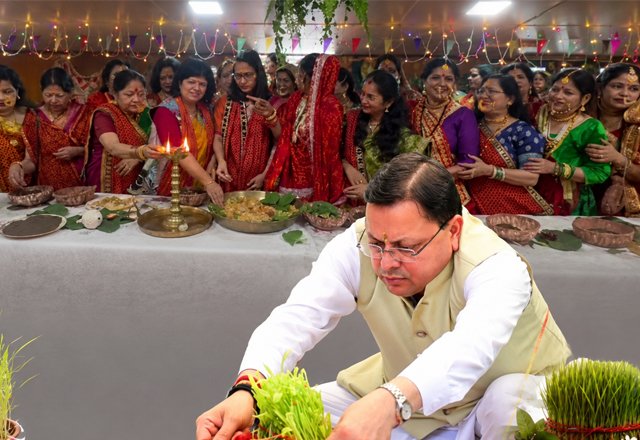
‘Harela’ is a folk festival of Uttarakhand dedicated to nature. Beyond symbolizing nature conservation and prosperity, it also holds religious significance as a celebration of the union of Goddess Parvati and Lord Shiva. This morning, the ‘Harela’—sown in baskets nine days ago—was harvested. The Harela shoots were placed on the heads of family members as a gesture of good wishes. A campaign to plant 10 lakh saplings across Uttarakhand is underway for the occasion. Chief Minister Dhami has also extended his greetings and best wishes to the people of the state on Harela.
Harela is not merely a folk festival; it symbolizes our reverence for nature, our commitment to environmental conservation, and our resolve to build a green future for generations to come. This festival inspires us to pledge to conserve our water, forests, and land, and to create a green and prosperous future for the next generation.
The Chief Minister stated that ‘Devbhoomi’ (Land of Gods) Uttarakhand is distinguished by its spirituality and rich cultural heritage. Its natural beauty and biodiversity captivate everyone; consequently, our responsibility towards environmental conservation becomes even greater. We must remain continuously committed to the rejuvenation and preservation of our water sources, rivers, and streams.
The Chief Minister noted that Prime Minister Narendra Modi’s “Ek Ped Maa Ke Naam” (A Tree in Mother’s Name) campaign has fostered public awareness regarding tree plantation. An effective action plan has been prepared by the Forest and Horticulture Departments to conduct massive plantation drives in both urban and rural areas of the state during the Harela festival.
He remarked that tree plantation has evolved from a mere social obligation into a cause deeply connected to public sentiment. This initiative will also help inspire future generations to connect with their traditions and fulfill their responsibilities towards nature conservation.
The Chief Minister called upon all the residents of the state to contribute to environmental conservation by planting as many trees as possible. Emphasizing the importance of public participation in this endeavor, he has appealed to all social organizations and institutions for their active cooperation.
It is noteworthy that while 10 lakh saplings are being planted across Uttarakhand today to mark the Harela festival, the Dehradun Municipal Corporation has distributed 5 lakh vegetable saplings under ‘Mission Poshan Sankalp’; this distribution was carried out through self-help groups in coordination with ward councilors. Additionally, drumstick (Sahjan) saplings are being planted in schools and Anganwadi centers as part of the same mission. A plantation drive involving public participation is also underway in public spaces and designated green zones, featuring the distribution of 70,000 saplings across various species, including fruit-bearing and fodder-yielding varieties.